
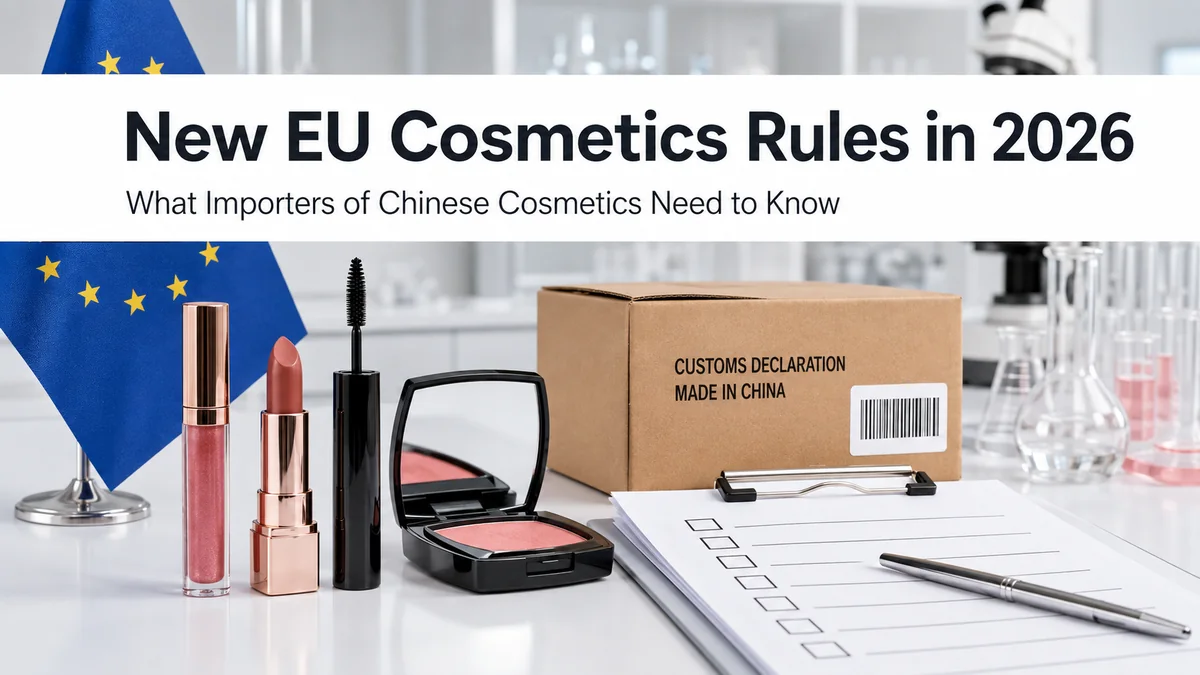
EU cosmetics regulations for Chinese imports changed in several important areas during 2025 and 2026. The changes do not create a separate legal regime for cosmetics made in China. Products manufactured in China must meet the same EU rules as products manufactured elsewhere before they are placed on the European Union market.
What has changed is the compliance workload. New ingredient restrictions, expanded fragrance-allergen labelling, packaging rules, and stronger market surveillance mean that EU importers need more complete information from their Chinese cosmetics manufacturer at an earlier stage. Formula, raw-material documentation, label artwork, packaging specifications, safety assessment, and notification can no longer be treated as separate tasks completed at the end of production.
Are There New EU Rules Specifically Targeting Chinese Cosmetics?
No. The EU Cosmetics Regulation is origin-neutral. The legal question is not whether the product was made in China, Korea, the United States, or the EU. The question is whether the cosmetic placed on the EU market complies with the applicable requirements.
However, an imported product creates a longer compliance chain. The EU brand or importer must obtain accurate information from a manufacturer outside the EU and make that information available to the EU Responsible Person, safety assessor, and authorities when required. Translation delays, incomplete fragrance declarations, outdated ingredient specifications, and last-minute artwork changes can therefore create a greater practical risk for imported products.
The Core Requirements Still Apply Before Import
Under the current consolidated Regulation (EC) No 1223/2009, a cosmetic product needs an EU Responsible Person before it is placed on the market. For an imported cosmetic, the importer is generally the Responsible Person unless another EU-established person is designated in accordance with the Regulation.
Before commercial placement on the EU market, the project normally needs:
- a final formula reviewed against the current EU annexes;
- a Cosmetic Product Safety Report prepared by a qualified safety assessor;
- a Product Information File kept accessible at the Responsible Person’s EU address;
- manufacturing information and a statement of compliance with cosmetic GMP;
- support for product claims where applicable;
- EU-compliant labelling in the required market languages;
- notification through the Cosmetic Products Notification Portal (CPNP).
A customs declaration, commercial invoice, or certificate of origin does not replace these product-compliance steps. Import clearance and legal market placement are related but different processes.
1. Expanded Fragrance-Allergen Labelling Is Now a 2026 Issue
Commission Regulation (EU) 2023/1545 expanded individual labelling requirements to cover 56 additional fragrance allergens and updated existing entries. According to the European Commission’s fragrance-allergen guidance, products that do not comply with the new requirements may no longer be placed on the EU market from 31 July 2026. Products placed on the market before that date may continue to be made available until 31 July 2028, subject to the transition rules.
For imports from China, the immediate impact is on formula documentation and packaging artwork. A brand may need a detailed allergen breakdown from the fragrance supplier, not only the word “fragrance” or “parfum” in a formula sheet. The safety assessment, PIF, ingredient list, and printed packaging must all reflect the same composition.
Before approving cartons or labels, the importer should confirm that the fragrance declaration covers the expanded Annex III list and that the assessment uses the final fragrance version. A later change in fragrance oil can require a new allergen review and revised artwork.
2. New 2026 Ingredient Restrictions Affect Future Orders
Commission Regulation (EU) 2026/909 amended the Cosmetics Regulation for substances including Benzyl Salicylate, Triphenyl Phosphate, aluminium-containing ingredients, water-soluble zinc salts, Acetylated Vetiver Oil, Citral, several hair dyes, and the UV filter DHHB.
The exact impact depends on the product category and concentration. For many of the new restrictions, non-compliant products may no longer be placed on the EU market from 1 January 2027, with later dates in 2028 for products already placed on the market to remain available. The Regulation also sets specific limits and conditions, so brands should review the legal text and current annexes rather than relying on a generic prohibited-ingredient list.
This creates a planning issue for orders manufactured in China during late 2026. Production date, shipping date, customs timing, and the legal date of placement on the EU market are not necessarily the same. A formula that can still be sold during a transition period may not be suitable for a new production run intended for placement after the deadline.
The practical response is to screen future formulas now, obtain current raw-material specifications, check relevant impurities where the Regulation requires them, and align the manufacturing schedule with the Responsible Person’s regulatory decision.
3. The TPO Prohibition Shows Why Annex Updates Matter
Commission Regulation (EU) 2025/877 applied from 1 September 2025 and prohibited Trimethylbenzoyl Diphenylphosphine Oxide (TPO) in cosmetics following its CMR classification. TPO had previously been permitted under specified conditions for professional artificial nail systems.
The lesson extends beyond nail products. EU compliance cannot be based only on a formula that passed review several years ago. Restricted and prohibited substance annexes change. Repeat orders, shade extensions, and products transferred to a new raw-material supplier should be checked against the current legal text before production.
4. The EU Microplastics Restriction Requires Long-Term Reformulation Planning
The REACH restriction on intentionally added synthetic polymer microparticles under Regulation (EU) 2023/2055 uses different transition periods for different products. Rinse-off cosmetics are covered from 17 October 2027, while leave-on cosmetics have a later transition. Lip, nail, and make-up products have a transition to 17 October 2035, with a required “This product contains microplastics” statement from 17 October 2031 for products that still fall within the relevant scope.
Not every cosmetic polymer is automatically a prohibited microplastic. The legal definition, particle form, solubility, degradability, concentration, and use matter. Importers should therefore request enough technical information from the Chinese manufacturer and raw-material suppliers to determine whether a polymer falls within the restriction.
For a new private label range intended to remain on the market for many years, early reformulation planning can avoid a second packaging and formula change later.
5. New Packaging Rules Add Another Compliance Layer
The Packaging and Packaging Waste Regulation (EU) 2025/40, known as the PPWR, began to apply on a phased basis from 12 August 2026. It covers packaging placed on the EU market regardless of its material or origin.
Many major design requirements are phased in later. The European Commission states that recyclability and mandatory recycled-content measures begin from 2030, and packaging-minimisation requirements also become important from 2030. This does not mean every cosmetic package must be redesigned immediately in 2026. It means brands developing new packaging now should understand the coming requirements before investing in molds, decorative components, multi-material assemblies, false bottoms, or excessive secondary packaging.
For Chinese packaging suppliers, EU customers will increasingly request material identification, packaging weights, component separation information, recycled-content evidence where applicable, and documentation supporting conformity. A visually attractive pack that lacks reliable material data may become difficult for an EU importer to approve.
6. Market Surveillance Is Becoming More Visible
The European Commission’s 2025 Safety Gate report recorded a high level of enforcement activity and identified chemical risks as the leading cause of alerts. Cosmetics were a major area of attention, including products containing banned fragrance substances and TPO.
For brands importing from China, the consequence is practical: authorities can evaluate the product, formula, label, Responsible Person information, and supporting file after market entry. A CPNP notification is not an approval and does not protect a non-compliant product from corrective action.
What EU Importers Should Request From a Chinese Manufacturer
A reliable compliance package should be built before the final purchase order and packaging print run. Depending on the product and Responsible Person requirements, the importer may request:
- the complete quantitative and qualitative formula information needed for safety assessment;
- current raw-material specifications and supplier documents;
- fragrance-allergen and relevant impurity information;
- microbiological, stability, and formula-packaging compatibility information;
- manufacturing method and cosmetic GMP documentation;
- packaging material composition, weights, and component details;
- final label artwork matching the approved formula and target languages;
- batch identification, traceability, and change-control records;
- samples from the production-representative formula and packaging.
The exact documents must be agreed with the EU Responsible Person and safety assessor. A manufacturer can supply technical records, but the Responsible Person remains responsible for the EU compliance decisions assigned to that role.
How the New Rules Change Sourcing From China
The main impact is not simply a higher testing cost. The sourcing sequence changes. Formula screening must happen before quotation is final. Fragrance data must be available before the ingredient list is approved. Regulatory artwork must be completed before packaging production. Packaging material data must be considered during design, not after shipment. Any change in raw material, shade, fragrance, or component should trigger a documented review.
Brands should also allow more time between sample approval and commercial launch. A lower unit price cannot compensate for a formula that must be reformulated, cartons that need reprinting, or goods that cannot legally be placed on the market after arrival.
Work With Ya-Orange on EU-Focused Cosmetic Development
Ya-Orange supports beauty brands with formula development, ingredient and packaging coordination, sampling, OEM/ODM production, and the technical information needed for the customer’s compliance review. For EU projects, we can coordinate product information with the brand, its Responsible Person, and its safety assessor before mass production.
Explore our cosmetics OEM/ODM process, review our quality control workflow, browse our private label makeup products, or contact Ya-Orange to discuss an EU market project.
Regulatory note: This article reflects publicly available EU information reviewed in September 2026 and provides general commercial guidance, not legal or safety-assessment advice. Requirements depend on the final formula, claims, packaging, product category, placement date, Member State, and Responsible Person assessment. Always verify the current consolidated legislation before placing a product on the EU market.