

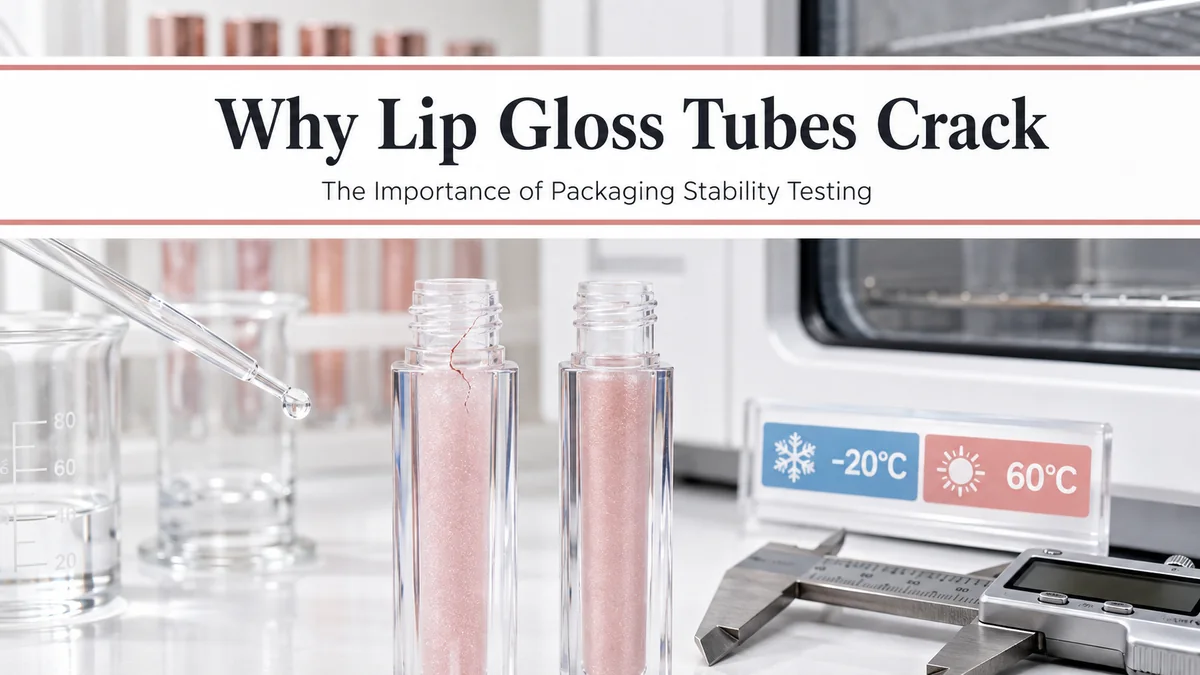
A cracked lip gloss tube is more than a cosmetic defect. It can cause leakage, contamination risk, damaged cartons, customer complaints, and an expensive packaging change after production. In many cases, the tube looked acceptable when it arrived at the factory. The crack appeared only after filling, assembly, storage, or transportation.
This is why lip gloss packaging stability testing should be completed with the actual formula and final packaging combination before mass production. A tube, cap, wiper, neck, and formula form one system. Testing each component separately cannot fully predict how that system will behave over time.
Why Do Lip Gloss Tubes Crack?
There is rarely one universal cause. Cracking usually develops when material selection, component dimensions, assembly stress, formula compatibility, temperature, or transport conditions interact. The visible crack may be the final result of stress that accumulated gradually.
1. Formula and Plastic Compatibility
Lip gloss formulas may contain oils, emollients, solvents, flavor components, pigments, and other materials that remain in direct contact with the container for months. Depending on the plastic resin and formula, certain components may be absorbed by the packaging, migrate into stressed areas, or change the material’s mechanical behavior.
This does not mean an ingredient is inherently unsuitable. It means compatibility must be evaluated for the specific resin, tube design, formula, contact time, and storage condition. ASTM explains that environmental stress cracking can depend on the material, container design, manufacturing conditions, and the liquid in contact with the package. Its ASTM D2561 overview also notes that laboratory results represent defined test conditions rather than every possible real-world situation.
2. Excessive Stress Around the Neck or Threads
The neck is a common high-stress area because several components meet there. If the wiper is too tight, the neck dimension is outside tolerance, or the cap creates excessive force, the plastic can remain under continuous strain. A small molded-in weakness may then grow into a visible crack during storage.
Threaded closures also require attention. ASTM maintains a specific method for evaluating the environmental stress-crack resistance of threaded plastic closures, listed as ASTM D5419. A brand does not need to apply every standard to every package, but the existence of these methods shows why closure stress should be treated as an engineering issue rather than only a visual inspection point.
3. Incorrect Component Fit or Dimensional Variation
A lip gloss package normally includes a bottle or tube, wiper, wand, cap, and sometimes decorative sleeves or collars. If one component changes between the approved sample and mass production, the fit may also change. Excessive interference between the wiper and neck, uneven wall thickness, molding marks, or dimensional variation can concentrate stress in one area.
For this reason, packaging approval should include the assembled system, not just separate photographs of the components. Critical dimensions and functional fit should be checked again when mass-produced packaging arrives.
4. Assembly Force and Cap-Tightening Conditions
A package that survives manual sampling may behave differently on a production line. Wiper insertion force, cap-tightening torque, equipment alignment, and assembly speed can affect the stress placed on the neck. Too much force may not break the tube immediately; it can create residual stress that becomes visible later.
Trial filling and assembly should therefore use production-representative components and settings. The team should record any whitening, deformation, thread damage, difficult opening, or early hairline cracking.
5. Temperature Changes During Storage and Shipping
Cosmetics may experience heat, cold, and repeated temperature changes during warehousing and transportation. The formula can expand, contract, separate, or change viscosity. Packaging components can also expand and contract at different rates. These changes may increase pressure, affect the seal, or reveal a weak point in the package.
Temperature testing should be selected according to the formula, packaging materials, intended shelf life, and expected distribution route. Extreme conditions should not be chosen only to make a marketing claim; they must have a defined purpose and acceptance criteria.
6. Drop, Vibration, and Carton Compression
A tube that is stable on a laboratory shelf may still fail during distribution. Repeated vibration, impact, and compression can loosen components or extend an existing microcrack. Inner trays, unit cartons, dividers, shipping cartons, and pallet configuration all influence the final result.
The International Safe Transit Association recommends selecting tests based on the actual distribution environment. Its packaging design and testing guidance discusses vibration, drop, compression, temperature, and humidity as relevant distribution hazards.
What Should Lip Gloss Packaging Stability Testing Include?
A practical test plan should use the intended bulk formula, production-representative packaging, final wiper and cap, normal fill weight, and the planned assembly method. The protocol and acceptance criteria should be agreed before testing begins.
Depending on the project, the evaluation may include:
- visual inspection for cracks, whitening, deformation, leakage, and print damage;
- formula-packaging compatibility under defined storage conditions;
- temperature exposure or cycling appropriate to the distribution plan;
- upright, inverted, and horizontal storage;
- wiper retention, insertion force, and leakage around the neck;
- cap fit, opening and closing performance, and controlled tightening conditions;
- wand withdrawal, application, and repeated-use checks;
- drop, vibration, and shipping-carton evaluation where relevant;
- comparison with an approved control sample at scheduled intervals.
The sample quantity, test duration, storage conditions, inspection intervals, and pass/fail criteria should be documented for the specific project. A short test on an empty component is not equivalent to compatibility testing with the filled product.
Why Stability Testing Must Happen Before Mass Production
Testing after all packaging has been printed and produced leaves few practical options. If cracking appears at that stage, the brand may face new molds, replacement components, reprinting, refilling, delayed delivery, or product loss.
Testing earlier allows the manufacturer and brand to adjust the resin, wall thickness, neck design, wiper fit, cap system, formula, assembly setting, or transport protection before the commercial order is committed. It also creates a clearer approval record for repeat production.
Packaging integrity also supports product safety. FDA notes that companies are responsible for cosmetic safety and identifies packaging that does not adequately protect a product as one possible route to microbiological contamination. The agency’s microbiological safety guidance and cosmetic GMP checklist provide useful context for handling primary packaging and finished products.
What Brands Should Confirm With Their Manufacturer
Before approving a lip gloss package, ask which material is used, whether the sample and mass-production components will come from the same specification, how the wiper and neck fit are controlled, which assembly settings will be used, and what filled-product tests are planned.
Also confirm who reviews the results, what constitutes failure, whether changes require retesting, and which approved sample becomes the reference for production. A verbal statement that a package is “compatible” is less useful than a documented test plan tied to the actual formula and final component set.
Develop Stable Private Label Lip Gloss Packaging With Ya-Orange
Ya-Orange supports beauty brands with lip gloss formula development, packaging coordination, sampling, compatibility evaluation, filling, and OEM/ODM production. Our goal is to identify packaging risks before mass production and keep the approved formula, components, artwork, and assembly requirements aligned.
Explore our private label makeup products, learn about our cosmetics OEM/ODM process, review our cosmetics quality control process, or contact Ya-Orange to discuss a custom lip gloss project.
Note: Test conditions and acceptance criteria should be selected for the specific formula, packaging materials, production process, intended market, shelf-life target, and distribution environment. This article is general manufacturing information and is not a universal test protocol.